• Style
    • Menswear
    • Accessories
    • Grooming
    • Style Inspiration
    • British Made
    • Collaborations
  • Lifestyle
    • Travel
    • Cars
    • Watches
    • Food & Drink
    • Arts
    • Events
  • People
  • UK-Made Menswear
  • About
  • Press

Grey Fox

A mature search for style. Fashion and menswear for all men.

Showing posts from category: Made in the UK

Ocha & Garth: Military Coat Made in London

Thursday, 22 February 2018

Ocha & Garth is a small menswear design business making distinctive menswear in Britain which fuses traditional tailoring techniques with very contemporary style. This ability to take a new look at classics has resulted in the Charles Military coat, which I wear here. It clearly has roots in the greatcoats that Guards regiments wear in the winter, with a huge collar and large flapped pockets. A couple of vertical pockets at lower chest height give a warm refuge for the hands on chilly days.

The Charles Military Coat - Harry thinks it should be called after him

Inside is a cotton gingham lining - lovely but slightly incongruous if  you expect something more military. Unlike many modern coats, it's a very generous length - down to the shins. The cloth is from A.W. Hainsworth of Leeds, England, who produce textiles for military and emergency services uniforms and indeed to cover the Woolsack in the House of Lords. Altogether it's a very classic coat with a contemporary, practical twist and perfect for the chilly days of winter and early spring. See Ocha & Garth for more information.


This feature is unsponsored and is written in support of a small menswear brand that makes in the UK and deserves our support. The coat was borrowed for the feature and returned (covered in dog hairs).
Share:
Labels: Made in the UK, menswear

Edward Green Shoes: Made in England

Sunday, 19 November 2017

Among my most comfortable shoes are these from Edward Green who've been making shoes in Northampton since 1890. Through careful attention to detail they've built an unrivalled reputation among shoe lovers. Having tried a couple of pairs I can now see why. The leather-soled suede derbies, although worn regularly for over a year now, have the unusual property of hardly wearing down at the heel, despite much London pavement bashing. They are a beautifully made pair of Cardiff derby brogues in olive suede. I'm lucky enough to have the same shoe in Delapré calf which is supple and soft to touch as it's been treated with nine different leather fats - this pair has a rubber Dainite sole.

My Delapré calf (left) and olive green suede Cardiff derbies from Edward Green

But how is it that such a stylish-looking shoe can be so comfortable? I asked Euan Denholm of Edward Green to explain these properties to me, surely a shoe is a shoe is a shoe? He told me, "Those soles and heels [on the suede derbies] are oak-bark tanned for nine months - it creates a sole which is highly durable yet light, comfortable and flexible (although one pays far more for the raw material!)". This underlines the importance not only of the quality of construction, but also of the materials used. There are no short cuts to true quality. See Edward Green.

The shoes were sent for review. This feature is unsponsored and all views expressed are mine alone.
Share:
Labels: Made in the UK, Shoes

Harris Tweed: A Journey to the Heart of the Hebrides

Wednesday, 4 October 2017

Looking into a piece of Harris tweed with a magnifying glass is like chasing down a fractal: you never quite seem to reach the end of the colours and textures in its depths. The cloth reflects its origins on Scotland's beautiful but exposed western Atlantic fringes. From the vast peaty moors of Lewis to the beautiful beaches, mountains and inlets of Harris, the Outer Hebrides are so interwoven with the tweeds they produce that its hard to appreciate the one without the other.

The white beaches of Harris

Harris tweed colours

Earlier this year I was privileged to be a guest of The Harris Tweed Authority on a journey to discover this most wonderful of tweeds. I knew, of course, that the cloth is woven in the homes of islanders, but the details of its story had escaped me. I gave a visual tour of its production on my Instagram account at the time and reproduce a few images here. 

To be a true Harris tweed, stamped with the Harris Tweed Authority seal of approval, the Orb, various legal requirements have to be met; in particular the need for it to be woven at home in Harris and Lewis, rather than in a mill. It's a product of a close partnership between three mills and a group of individual weavers who produce the cloths which are so appreciated around the world.

I visited one of the mills that prepare and dye the wool (Harris Tweed Hebrides in Shawbost; see images below), spin it into yarn which is warped onto beams which are sent out to the weavers for the cloth to be woven. The weaver adds the weft to the warp and returns the cloth to the mill to be finally washed and checked, stamped with the Orb and distributed. This isn’t a mass-produced product, it’s a home-made cloth that contains the essence of the islands in which it’s made. The depth of colour results from the wool being dyed before spinning, rather than the yarn being dyed after it's been spun. The process is illustrated below:

Dying the wool


Blending colours to make the tweed required


Spinning the yarn

Warping the yarn onto a beam to be sent to the weavers to complete the cloth in their homes

Once back from the weavers the cloth is carefully finished (washed to make it softer), checked for defects and has the famous Orb applied before being packed and despatched all over the world.

The weavers return the woven cloth to the mill for finishing and checking

Checking the cloth to ensure it's perfect

The orb is applied - I was given a length of this very cloth

I also visited some of the weavers in their homes (below). Most work in weaving sheds next to their houses on modern looms that weave full width cloth. Some still use older Hattersley looms, which produce half width cloth. Some carry out the whole process, from warping to weaving, rather than relying on a mill to deliver the warped beams. These few produce limited runs of unique cloth that are much sought after. 

At present the future of Harris tweed and the craft of weaving looks secure; but it would be more so if we all appreciated the value of this product and went out of our way to support it by buying Harris tweed off-the-peg clothing, furnishings and accessories or by asking our tailors for it by name

Weaving the cloth

A Hattersley loom

Donald John McKay MBE, with his Hattersley loom (top) and his own tweeds, used by tailors such as Brita Hirsch

I was pleased to be given a length of Harris tweed during my visit to Shawbost. I'm collaborating with bespoke tailor Brita Hirsch to make this into a jacket showpiecing the best of tailoring and the best of Scottish tweed; but that's another story: keep an eye on my Instagram account and on here for more.

I'm grateful to Leica UK for lending me a Leica Q for the trip. I'm no photographer, but the quality of the images it captured, often in dark weaving sheds, was quite outstanding. The top two and final three images here are taken with the Leica Q, the remainder with my Fuji X100S.

I'm very grateful indeed to the Harris Tweed Authority, whose guest I was. I received no payment. All views are my own.

Links:
Harris Tweed Authority - here you can find out more about how the tweed is made
Harris Tweed Hebrides
Leica Q
Brita Hirsch Tailor

Books:
Harris Tweed; From Land to Street by Lara Platman - a photographer looks at everyone involved in making the cloth.
From The Land Comes the Cloth by Ian Lawson - a sumptuous photographic record.
Share:
Labels: Harris Tweed, Made in Scotland, Made in the UK, Tweed

Pajotten: A New Menswear Brand Making in the UK

Thursday, 28 September 2017

I'm always excited when I stumble on a new menswear brand, particularly where it's making its products in the UK. Pajotten, whose simple clothing finds its inspiration in workwear, uses natural fibres like linen and cotton drill, to make clothes to order in their Kent studio.


I've tried one of their indigo chore jackets (above). I tend to appear here and on social media dressed in tailored garments, but my natural bias is towards the casual and I've really enjoyed the comfort and utilitarian nature of this piece, made of Lancashire woven cotton drill. I've no doubt that it'll wear well and gain a subtle patina of use as it wears and fades.

I spoke to founder Rebecca Barton to ask her more about Pajotten:

Tell us about Pajotten; when did you start it and what are its aims?

I studied fashion design years ago, (MA at Central St. Martins alongside Lee McQueen) but with a young family and the need for financial security I combined working in a previous business (with Cushlab) with teaching fashion design at university level (Ravensbourne in London). I had always wanted to run my own fashion company but lacked the courage and time until last year when I thought now or never and just did it. The point of change was when for Christmas 2015/16 I made my partner a copy of an old vintage chore jacket. I copied in details like how the sleeve had twisted and the front had dropped down, and cut them into the new garment; it was an instant hit and led to conversations about leaving my job. I can honestly say I have never been happier.


You make in the UK. Is this a core value of the business? Would you make outside the UK? 

It was really important to me that we made in the UK. I know some people who have made abroad and it is really difficult to oversee, plus I am really hands on, the idea of making in huge quantities, not being able to alter designs immediately and without huge cost doesn't appeal at all whereas the idea of employing locally and building up a relationship with a small quantity of makers does. The business was just starting as the Brexit vote came in... that really confirmed for me the importance of trying to source and manufacture everything where possible in the UK. I am committed to this; I think it's the only way Brexit can work.


Tell us about Pajotten's products.

It's currently a small capsule collection of 8 pieces in different fabrics. The focus is on creating quiet, contemporary clothing, simple garments in natural fibres. Detailing is considered and kept to a utilitarian minimum. Importantly, the garments are a reflection of what we enjoy wearing, and feel confident in. While the detailing is pared down our sizing is generous, we want people to feel comfortable in the clothes, pockets are deep and sleeves and hems are wide.

Always averse to the waste and environmental impact of the fashion industry, we aim to do things differently. Firstly, all of our pieces are made to order individually in our family run Kent studio and finished by hand. This means there aren’t lots of unsold garments thrown into landfill, instead garment will be made individually by a maximum of two people, and dispatched within 2 - 4 weeks and because it will be made to order rather than made to measure, it can be returned.

Sustainability also impacts the fabrics we use, we are very keen to support British manufacture so everything we use including fabrics, trimmings and buttons are either sourced from UK mills and companies, or bought as 'deadbolt' from designer level studios. 

Because we are a small brand we are able to do things differently, rather than working to fixed seasons we simply add new pieces when we feel they are needed, this means there will always be something new on the website while favourites will stay available. We are also keen to communicate directly with customers, and are happy to send out fabric swatches prior to purchase.


How do you see the business developing?

We are only just beginning, so for the next couple of years the plan is to establish ourselves, refine and improve what we offer, and how we offer it, but in the future I would love to have a few physical outlets in the UK. I think that the world is changing rapidly, how people shop and what they value within that is also in flux, so I would love to create a range that reflects that properly, something that I don't think huge brands can do, we are now also working on a complimentary womenswear range, at the moment it is 8 pieces at is looking good.

To order or find out more, visit Pajotten. 

The jacket was sent to me by Pajotten for review.
Share:
Labels: Made in the UK, workwear

Billy Tannery: An Exciting Enterprise Launching Today on Kickstarter

Wednesday, 24 May 2017

In the week of Meet the Manufacturer, that celebration of British manufacture, it's good to bring news of the launch of Billy Tannery on Kickstarter (links below). Another new enterprise from Britain's exciting new wave of young entrepreneurs, Billy Tannery is, as its name suggests, a brand which makes products from kid goat leather tanned in their small-batch tannery or ‘microtannery’.

Image Grey Fox

Founders Jack Millington and Rory Harker (both aged 28) discovered that a growth in demand for goat meat in the UK had coincided with the decline of the British leather industry, leaving thousands of British goat hides going to waste. In response they have collaborated with ethical goat meat supplier Cabrito to use leftover hides to produce premium vegetable tanned kid leather in their new tannery near Northampton. 


Billy Tannery is launching a range of luxury kid leather bags and accessories that are designed and handmade in Britain. I recently had a preview of some of these products and can confirm that they are beautifully designed and made. The first range of Billy Tannery products launches on the crowdfunding site, Kickstarter, today, 24th May 2017. 

Please get behind another exciting young brand whose vision is to design and manufacture here in the UK. Our support is needed, especially at a time when the UK, Brexit bound, needs more than ever to promote its own wares. Here are the web links:

See Billy Tannery on Kickstarter to support them as they launch.
See Billy Tannery for more information.
Meet the Manufacturer.
Cabrito Goat Meat Ltd.

This is an unsponsored feature. If you'd like to support Grey Fox Blog please email me here.
Share:
Labels: British made, leather goods, Made in the UK

Blackhorse Lane Atelier: Denim Jeans from East London by Alex Hughes

Monday, 7 November 2016

I'm very grateful to reader Alex Hughes, budding blogger, friend of Grey Fox Blog and menswear aficionado for this report on Blackhorse Lane Ateliers, a company making denims in East London:

The debate over jeans and the mature gent won't go away any time soon, but I hope that readers of this blog would agree with the proposition that, with certain caveats (such as quality, wash and fit), there is no reason for any arbitrary limit on the ability of a gent to wear jeans at any age. With that in mind, along with importance Grey Fox blog places upon supporting British manufacturing, this correspondent paid a recent visit to Blackhorse Lane Ateliers, a relatively new but exciting operation based in East London.


Launched in April this year (after over a year of planning and preparation) by Han Ates, who has over twenty years experience in the clothing and textile industry, Blackhorse Lane Ateliers is a project which is the antithesis of disposable fashion. Having purchased three pairs of jeans from a major brand at the beginning of 2015 and having been unimpressed with the quality of construction, along with noticing that each pair had been produced in a different country, Han was moved by a desire to produce a quality item using traditional ‘Heritage’ manufacturing techniques, employing local workers in the process.


His recent experience hasn’t been easy though, and underlines the value in supporting British brands which manufacture in this country and thereby maintain a skilled workforce; 21 years ago when setting up another clothing operation, he advertised for workers and 3 weeks later had 110 applications. This time around, after 4 months he had 9 applications. The current workforce is a mixture of experienced workers and trainees learning the skills needed to produce garments to a high standard.


The result is a range of styles named after London postcodes in a variety of weights of selvedge denim, sourced from (currently) Turkish and (more familiar to the denim heads out there) Japanese mills. Given the emphasis on the quality of materials and care to the manufacturing process the jeans are not cheap, but having borne witness to both it is highly believable that by measuring value in the perennial ‘cost per wear’ metric, they will actually prove much cheaper in the long run, as well as being more pleasurable to wear.


It’s difficult not to be impressed with both their dedication to the quality of their products and high ethical standards they set themselves with regard to the environmental impact of their production. Other projects include growing their own indigo for future use in their jeans, and giving back to the local community, such as providing open days for school children to encourage an interest in clothing manufacture and make them think about the provenance of the clothes they wear. See Blackhorse Lane Atelier Denim


Contributed by Alex Hughes. This is an unsponsored post and all views are those of the author and this blog.
Share:
Labels: denim, jeans, Made in the UK

Campbell Cole Simple Collection: British made leather accessories

Thursday, 29 September 2016

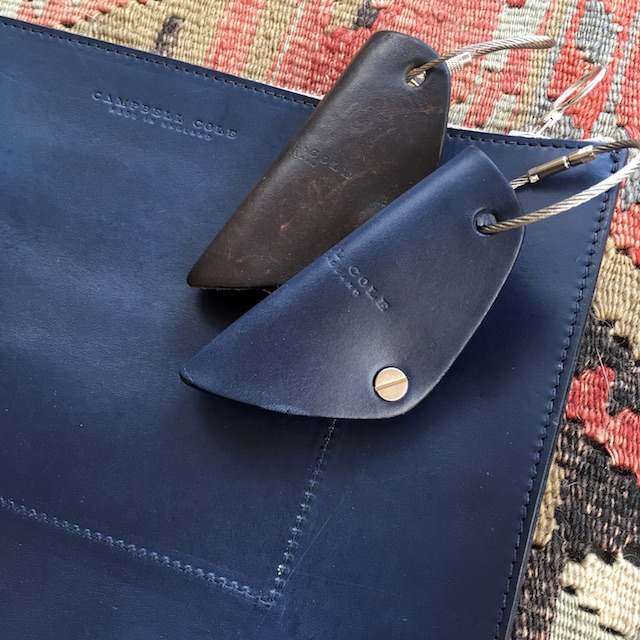
Campbell Cole's products are infused with a minimalist, high quality design ethic that always leaves me totally impressed. I've featured their British-made products here before. The products in the Simple Collection are made from Italian vegetable tanned leather and develop a patina of age, looking better and better as they're used. 


I've used one of their key wraps for a few years and it's never let me down - as well as looking good. The Simple A5 pouch, leather on one side and suede on the other, either slips inside a brief case or can be used to carry all those little objects (keys, wallet, passport, phone) that would otherwise ruin the carefully tailored lines of one's jacket or trousers.


I'm in awe of this young enterprise. They've never compromised on their pursuit of the highest quality and design. If these objects were embossed with other certain international high-luxury fashion names they would cost several times as much and wouldn't be as good quality (and probably be made in Asia). There are other pouches, wallets and holder in the Simple range. Go to Campbell Cole to find out more.

I was sent some of these objects for review. I've received no compensation for this feature and the views expressed are entirely my own.

Share:
Labels: leather, leather goods, Made in the UK

Wicker picnic hampers from GW Scott: made in England

Tuesday, 14 June 2016

The warmer weather brings Ascot, Henley, Glyndebourne and picnics, meals on the beach and barbecues. Such serious things need to be done in style with traditional wicker hampers made in England.


GW Scott was established in 1661 and invented the wicker picnic hamper in 1851. The company has been revived and makes its baskets and their contents entirely in the UK. They use the best of what is available and hundreds of hours of labour go in to making each basket and hamper.


The relaunch of the brand this spring saw the introduction of two new hampers to celebrate 355 years of GW Scott and 165 years of the picnic basket. For more information, and to buy, visit GW Scott.

I was not compensated for this post. 
Share:
Labels: Made in the UK, picnics

Denim umbrellas from London Undercover: made in London

Wednesday, 8 June 2016

My London Undercover Prince of Wales check umbrella keeps me stylishly dry, but their new denim brollies, made by hand in London, have me itching for one to match my jeans.


Inspired by French field workers’ indigo-dyed brollies from the early 20th century, a specialised waterproof cotton-based denim twill has been created in four shades of denim. This high quality British-made brolly is available from London Undercover for £185.

This post is unsponsored.
Share:
Labels: Made in the UK, umbrella

Ettinger x Gaziano & Girling and Great Creations Exhibition

Monday, 6 June 2016

During London Craft Week last month, British manufacturers Ettinger (leather wear) and Gaziano & Girling (footwear) showed a bag and shoes created in collaboration to show the best of British shoe making and leather working. This video tells the story:


The Ettinger x Gaziano & Girling portfolio is now touring the world with the GREAT Creations Exhibition which promotes the best of the UK to international audiences, encouraging them to visit, study and do business in the UK. The exhibition features the best of British design and craftsmanship, including contributions from David Bailey CBE, Nicholas Oakwell, Mulberry and Aston Martin. See more on Great Creations here.

For more on Ettinger, click here.
For more on Gaziano & Girling, click here.

This post is unsponsored.
Share:
Labels: footwear, leather goods, Made in the UK

British Boxers invade Harrods

Monday, 23 May 2016

It's always good to hear that one of my favourite British brands has done well. British Boxers' Deborah Price tells me that her UK-made men's underwear has been accepted at Harrods. It's a pleasure to see that store recognising a small business producing most of its products in the UK.


Deborah was so pleased to be packing her first orders for Harrods that she mentioned it on Linkedin, only for the news to go viral as so many shared her obvious pleasure. Her trip to success has been a hard one, as she recounted in her Linkedin post, as follows:


I know how hard Deborah has worked for this and have seen her selling her products at the fair at L'Eroica last June. I know something of her challenges in developing a new business and caring for a disabled daughter with Williams Syndrome (a bit like Downs Syndrome). I therefore share her obvious delight at the Harrods deal.

British Boxers are well-made, high quality boxer shorts made in England. Please make sure your underwear drawer has several examples of Deborah's products. See British Boxers to buy.

This post is unsponsored.
Share:
Labels: Made in the UK, underwear

A visit to Hand & Lock embroiders and Alice Made This

Thursday, 14 April 2016

I love visiting factories and workshops to see British-made menswear and accessories. So many of these businesses date back a century or more. Hand & Lock are no exception; they've produced the finest hand embroidery since 1767. 

Traditional military and ceremonial embroidery and gold work

Contemporary embroidery work

As with so many other UK manufacturers I've see, they haven't allowed the grass to grow under their feet. While they still produce military regalia and insignia, they do this alongside some very contemporary and fashion-oriented work (see above). 

My visit was arranged by Alice Made This whose cufflinks and lapel pins I've featured before here. Below I wear a borrowed example of Hand & Lock's work for  Alice Made This. 

Wearing the Alice Made This Milne lapel pin: £195

One significant difference to many of the other businesses I've visited is that the workforce is very young. It's a sad fact that most skilled hand manufacturing businesses seem to depend on migrant workers or those over 40. Why the UK cannot attract its youth to the glamour and satisfaction of making things is a much-discussed issue - but it was refreshing to see so many young people working away on the detailed, intricate and highly skilled work required of an embroiderer.


I saw examples both old and new of the goldwork and other embroidery for which Hand & Lock is famous. The company came into being when M. Hand and S. Lock merged in 2000. Before that date S. Lock worked on couture for the Royal Family and top design houses, while M. Hand (the original Mr Hand had been a Huguenot lacemaker from Flanders) focused on traditional military and ceremonial embroidery. This mix is reflected in the wide range of work being carried out, from high fashion to very traditional ceremonial embroidery.


I was shown how original designs are transferred from tracing paper by pricking round a drawing and then saw the fine work of cutting and placing the fine coils of gold thread (actually two percent gold) called bullions to make up the designs. A machine (called  bullion twist) twists the gold wire to make each bullion. Everything is done by hand.


The lapel pins of Alice Made This are each a celebration of the goldwork traditions and skills displayed by Hand & Lock for military and ceremonial wear. Each piece, made in London, uses skills applied for hundreds of years. To see more, visit Alice Made This. See Hand & Lock for more on the skills used to make their products.


Campbell and Aldringham lapel pins from Alice Made This (£205 to £220)

[Note: this is an unsponsored feature, I have received no gifts or payment].
Share:
Labels: jewellery, Made in the UK
Home
Older Posts
Subscribe to: Posts (Atom)

Vuelio Top 20 Fashion Blog 2023

Vuelio Top 20 Fashion Blog 2023

Follow

Search This Blog

Popular Posts

  • The Grey Fox Shop re-opens - my favourite products chosen for you
    Some hard work has brought the re-opening of the Grey Fox Shop , giving me the chance to offer blog readers a constantly-changing selection...
  • The New Land Rover Defender After Three Years
    A year ago I reported (below) on my first two years ownership of the new Land Rover Defender, which I bought in late 2020 and which was deli...
  • Shaun Gordon: Bespoke Tie Maker
    It's nearly seven years since I last spoke to Shaun Gordon , tie maker extraordinaire, here on the blog (link below). An update was lon...

Categories

  • People
  • lifestyle
  • style

SARTORIALAB

SARTORIALAB
Personal Styling Service

Grey Fox on Pinterest

Visit Grey Fox's profile on Pinterest.
Powered by Blogger.
© Grey Fox · Theme by xomisse